
Guide · Regulation
Fluorescent lamp ban UK: what happened, what's still coming, and how to upgrade to LED.
Last reviewed: August 2026
The fluorescent lamp ban is no longer something to prepare for. In Great Britain the main phase-out dates passed between September 2023 and February 2024, a further set of restrictions took effect on 31 December 2025, and the next deadline — the one most building owners have not noticed — falls in February 2027 and covers metal halide and high-pressure sodium.
If you still have fluorescent lighting in your buildings, nothing about it is illegal. But the lamps are no longer being made for the GB market, replacement stock is finite, and the way you replace them carries compliance consequences that a like-for-like swap used to avoid. This page sets out the dates as they actually stand, and what a building owner sensibly does next.

The rules
What the ban actually restricts.
Two separate sets of rules did the work, and they are often conflated.
Ecodesign
Sets a minimum efficacy for light sources placed on the market. Fluorescent lamps in the most common formats could not meet it.
UK RoHS
The Restriction of the Use of Certain Hazardous Substances in Electrical and Electronic Equipment Regulations caps mercury in electrical equipment. Fluorescent lamps worked by passing a current through mercury vapour, so they only remained legal under specific, time-limited exemptions. As mercury-free LED alternatives became available, those exemptions were allowed to expire.
Both regimes restrict placing a product on the market — manufacturing it, importing it or selling it new. Neither requires you to remove a working lamp from a ceiling. That distinction matters, and it is where most confusion about the ban comes from.
Dates
The GB timeline, corrected.
| Date | Regime | What it covered |
|---|---|---|
| 1 September 2023 | Ecodesign | T8 fluorescent tubes in the common lengths (2ft, 4ft and 5ft) could no longer be placed on the GB market. |
| 1 February 2024 | UK RoHS | The remaining T8 lengths, all T5 linear fluorescent, non-integrated compact fluorescent (CFLni), the long-life variants, and high-pressure sodium lamps with improved colour rendering (SON Deluxe). |
| 24 February 2025 | UK RoHS | Single-capped fluorescent for special purposes, non-linear tri-band phosphor lamps, and cold cathode / external electrode fluorescent lamps (CCFL and EEFL). |
| 23 December 2025 | Control of Mercury | Manufacture, import and export of a wider list of mercury-added lamps prohibited in Great Britain, staged across 31 December 2025, 2026 and 2027. |
| 24 February 2027 | UK RoHS | Current expiry date for the mercury exemptions covering metal halide, high-pressure sodium and ultraviolet lamps. Extensions have been applied for; the outcome is not settled. |
A correction we've kept visible
The February 2024 date is the one to remember, and it is not the date this page originally gave. When this article was first written in early 2023, the expected GB cut-off for linear fluorescent was 1 September 2023, in line with the EU. The final GB legislation — the RoHS amendment regulations made in July 2023 — set 1 February 2024 for most linear and compact fluorescent categories, with only the common T8 lengths caught earlier by Ecodesign. We have corrected it here rather than quietly deleting the page.
What changed next
Two things that changed after the fluorescent deadlines.
The mercury rules closed the manufacturing route.
The Control of Mercury (Amendment) Regulations 2025 came into force on 23 December 2025 and prohibit the manufacture, import and export of a longer list of mercury-added products in Great Britain, including several categories of compact, linear and non-linear fluorescent lamp. RoHS had already stopped these being sold new; this removes the remaining production and export routes, staged as follows:
- 31 December 2025 — integrated compact fluorescent lamps of 30W or less
- 31 December 2026 — non-integrated compact fluorescent 30W or less, compact fluorescent above 30W, and halophosphate linear and non-linear fluorescent lamps
- 31 December 2027 — triband phosphor linear and non-linear fluorescent lamps
February 2027 is the live deadline.
The GB RoHS exemptions for metal halide, high-pressure sodium and UV lamps are currently due to expire on 24 February 2027. Industry bodies have applied for extensions, and until those are determined nothing is certain either way. But if your estate includes car parks, sports pitches, external and amenity lighting, high-bay or industrial areas, the lamps in them are on a shorter clock than most people assume, and planning on the basis that "the ban was about tubes" is a mistake.
Beyond Great Britain
Northern Ireland and the wider picture.
Northern Ireland continues to follow EU rules under the Windsor Framework. Under the revised EU Mercury Regulation (2024/1849), manufacture and export of halophosphate linear and non-linear lamps and compact fluorescent for general lighting ended on 31 December 2025, with triband phosphor lamps following on 31 December 2026.
That produces a real divergence worth knowing about if you operate on both sides of the Irish Sea: triband linear fluorescent manufacture ends a full year earlier in Northern Ireland (end of 2026) than in Great Britain (end of 2027).
Globally, parties to the Minamata Convention on Mercury have agreed a full phase-out of fluorescent lighting — compact fluorescent lamps by 2025, agreed at COP-4 in 2022, and linear fluorescent lamps by 2027, agreed at COP-5 in 2023 — with narrow exceptions for specialist applications. Whatever happens to individual exemptions, the manufacturing base for fluorescent lamps is being withdrawn worldwide. There is no version of the next few years in which fluorescent supply recovers.
Exposure
If you still have fluorescent lighting.
You are not in breach of anything. What you are exposed to is availability.
Stock is finite and no longer replenished.
Retailers could sell through existing inventory, and much of that has now gone. Remaining stock commands a premium, and lengths and colour temperatures become patchy before they disappear.
Emergency and specialist fittings are the tight spot.
General-purpose 4ft tubes are the easiest to find. A specific compact fluorescent for a bulkhead in a stairwell, or a lamp for an emergency luminaire, is where estates run out first.
Partial failure creeps.
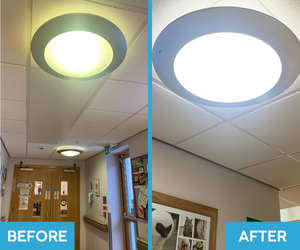
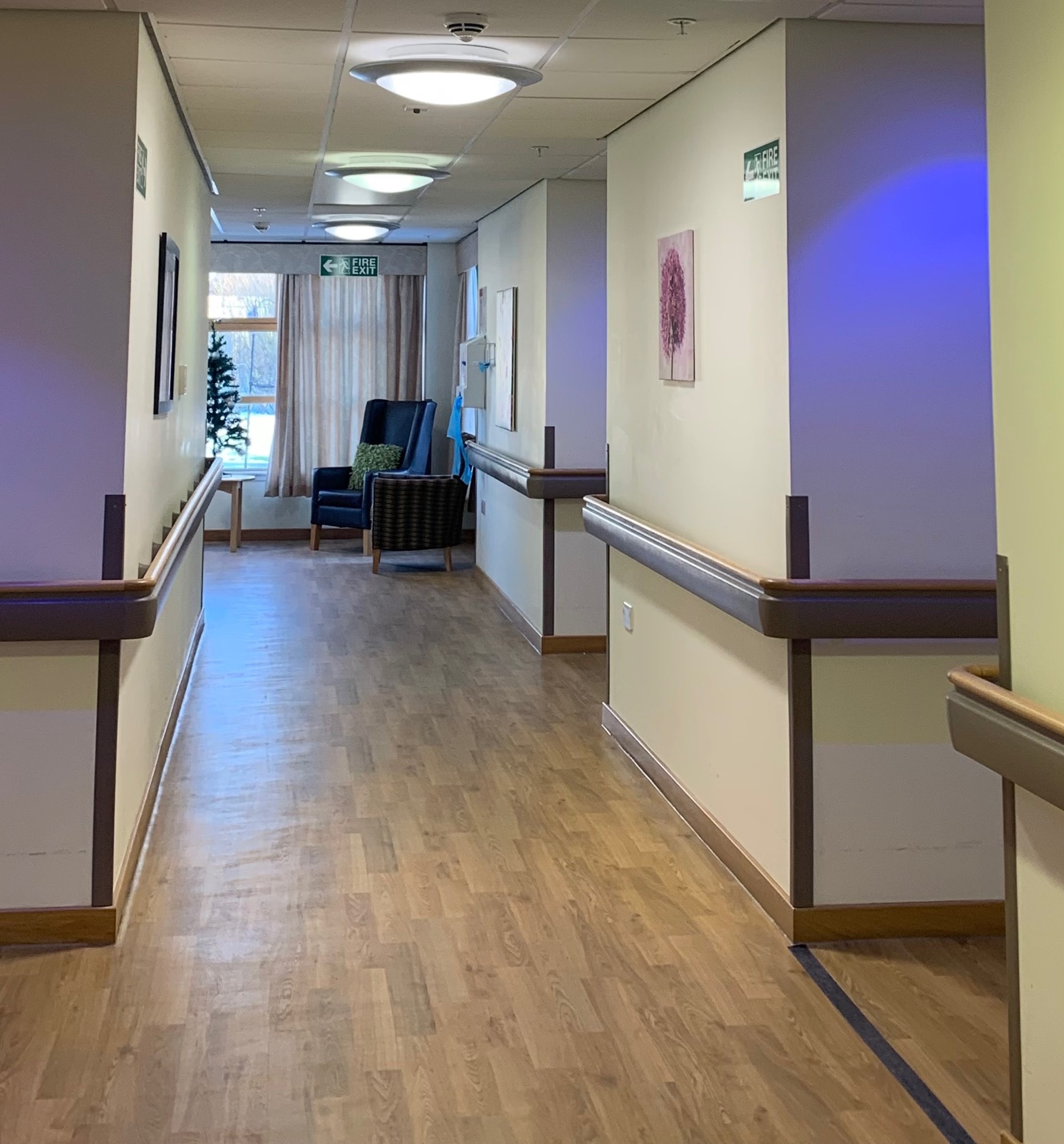
Buildings rarely go dark. They lose a tube here and a fitting there, and because nobody is measuring, the drift is invisible until someone does. On one Scottish sheltered housing survey we recorded a first floor at a minimum of 2 lux against a ground floor reading 417–509 lux — largely failed tubes that nobody had reported. You can see the kind of work this comes from in our case studies.
The practical position: you do not need to strip out working fluorescent lighting this year, but you do need a plan for the buildings where a failure cannot be fixed with a spare from the store cupboard.
The options
Your three options for upgrading to LED.
There is no single right answer, and anyone who gives you one before looking at your fittings is guessing. The honest comparison is this.
01
LED replacement tube in the existing fitting
Cheapest per position, quickest to install, and genuinely the right answer in some buildings — typically newer fittings in good condition, in non-critical areas, where the existing lighting design still holds.
- Most LED tubes require the existing control gear to be bypassed, which means rewiring inside the luminaire. Manufacturer guidance is that where the owner retains the luminaire and the conversion follows the tube manufacturer's instructions, no fresh conformity assessment is required — but the fitting on your wall is no longer the product the original safety certification to BS EN 60598 described, the original manufacturer's warranty is unlikely to survive it, and responsibility for the modification sits with whoever carried it out. The work needs documenting, and the instructions need following exactly.
- Tubes that run through the existing fluorescent control gear without rewiring avoid the modification question, but you carry the losses of gear designed for a different lamp and you inherit its remaining life — a ballast failure still takes the fitting out.
- The light distribution changes. An LED tube does not emit in the same pattern as the fluorescent lamp the reflector was designed around. Illuminance and uniformity against BS EN 12464-1 are no longer assured by the original design, and in corridors and stairwells that is where problems show up.
02
Change the gear tray or LED module in the existing housing
A middle route: retain the housing and diffuser, replace the internals with a purpose-designed LED gear tray. Better optical and electrical outcomes than a tube swap, and it keeps the existing appearance — which matters in listed buildings and in occupied schemes where residents notice change.
- Still a modification, with the same responsibility point as above, so the work and its certification need to be documented properly.
03
New LED luminaires
Most expensive up front, and the cleanest position: a current product, a current declaration of conformity, a manufacturer's warranty, a photometric file you can design against, and no argument about who is responsible for what.
The right choice usually varies within a single building, not across a portfolio — which is why we survey every position before quoting rather than pricing a building as a single number.
The part most upgrades get wrong
Emergency lighting.
This is where a fluorescent-to-LED upgrade stops being a procurement exercise.
The code of practice has changed. BS 5266-1:2025 has replaced the 2016 edition, and it references BS EN 1838:2024 for the performance criteria. Existing installations are not automatically non-compliant because the standard changed — be sceptical of anyone who tells you they are. What has changed is what you are expected to be able to evidence, and what applies when you upgrade or extend an installation. An LED conversion is an upgrade.
The emergency supply calculations.
Where emergency luminaires or a central supply are changed to LED, the power supply requirements need recalculating — in both watts and VA, allowing for power factor and inrush current, which behave materially differently with LED drivers than with the fluorescent loads the original calculation assumed. If your building has had a lighting retrofit in the last decade, it is worth asking whether that calculation was redone. In our experience the answer is frequently no, and the records then no longer describe the installation.
Measured light levels.
BS 5266-1:2025 expects the photometric performance of an emergency lighting system to be verified initially and at intervals not exceeding five years, using calibrated equipment, with the results recorded. That is a different question from the monthly and annual tests, which establish that the luminaires operate. A fitting can pass every test it has ever had while the corridor it serves sits below the required minimum — because lumen depreciation, a yellowed diffuser, a changed floor finish or a non-equivalent replacement lamp do not stop a luminaire working.
If you are changing emergency luminaires anyway, that is the cheapest moment in the next five years to establish the measured baseline.
Duty of care
Don't forget the disposal.
Fluorescent lamps contain mercury. They are hazardous waste — special waste in Scotland — as well as falling under WEEE. They cannot go in a general skip, they should not be broken on site, and removal carries a duty of care: a registered waste carrier, the correct paperwork (a Special Waste Consignment Note in Scotland, a hazardous waste consignment note in England and Wales), and records retained for at least three years.
On a relight of any size this is a real quantity of hazardous waste leaving your building. If your contractor's quote does not say how it is being handled and what paperwork you will receive, ask before the work starts, not after.
Our approach
How EGG Lighting approaches a fluorescent upgrade.
We are a Glasgow-based commercial and public sector lighting contractor. On a fluorescent replacement programme, the sequence we work to is:
1
Survey every position before anyone quotes.
Fitting type, load, mounting, condition, emergency and sensor function, photographed, recorded individually. Not a sample and not a walk-round count. It is the only basis on which the tube-versus-gear-tray-versus-new-luminaire question can be answered honestly, position by position.
On three occupied Scottish sheltered and later-living schemes we recorded 621 luminaire positions individually — the kind of programme set out in our case studies.
2
Tell you where we are not the answer.
On one of those schemes we advised the client that 140 fittings should be conventional new product rather than the option that suited us better. We would rather lose a line item than defend a recommendation we do not believe.
3
Relight and certify as we go.
Delivered circuit by circuit in occupied buildings, with per-circuit Minor Works Certificates to BS 7671 and emergency lighting completion certification. Our work in occupied sheltered housing has been delivered without decanting residents.
4
Hand you the record.
At the end of the job you receive your own lighting asset record — every position, what is installed, its load, its emergency function, its test and certification history — in a format you keep, whether or not you ever use us again. Not a login and not a subscription. Most contractors keep that data in their own system, which means you are renting access to facts about your own building.
Talk to us about your fluorescent lighting.
If you have fluorescent lighting still in service and want to know what is actually on your walls and what it will take to replace it, we will come and look at it.
Email enquiries@egglighting.com to arrange a site survey, or send us the details here.
Conversation, not tender
Start with a conversation.
No tender process required. No sales pressure. A straight answer about what your estate is worth.