
Insights · Circularity
A way to actually measure whether a light fitting is circular.
A circular economy keeps resources in use for as long as possible — designing products so they can be disassembled, repaired and remanufactured, rather than landfilled and replaced. That's the principle. TM66 is what turns it into a number.
Core principle
Circularity claims should be checkable, not just asserted.
CEAM-Make
Scoring a product's circularity.
Published by CIBSE's Society of Light and Lighting in October 2021, TM66 gives the lighting industry a structured way to assess circular economy performance — not just describe it. Its assessment tool, the Circular Economy Assessment Method for Manufacturing (CEAM-Make), works through a detailed question set — 72 in EGG Lighting's assessment — across four areas of a product's life, with most answers requiring supporting evidence.
- 01
Product design
Is it built to last, and can it be repaired? A fitting that can be opened up and fixed instead of thrown out is doing the basic job of a circular product.
- 02
Materials
Does it use recycled content, or virgin material by default? CEAM-Make marks products down for defaulting to virgin resources when recycled alternatives exist.
- 03
Manufacturing
How is it actually made? Efficient processes that cut waste score higher than ones that don't.
- 04
Ecosystem
Does the manufacturer support the product after it's sold — repair, upgrade paths, take-back — or does the relationship end at the point of sale?
The output
Each question is scored, and the output is a single figure. That single figure is the point: it gives a specifier or estate owner something concrete to compare across products, instead of taking a manufacturer's sustainability claims on trust.
Why it matters beyond the score
One standard the whole supply chain has to answer to.
TM66 pushes the whole supply chain — specifiers, manufacturers, contractors, facilities managers — toward the same standard: design for disassembly, design for a longer life, and be able to prove it. That's a meaningful shift for an industry where "sustainable" has historically meant whatever a manufacturer wanted it to mean.
How EGG Lighting uses it
Scored, not described.
We think circularity claims should be checkable, not just asserted. That's why we score our products against TM66's published CEAM-Make method rather than describing them in our own words.
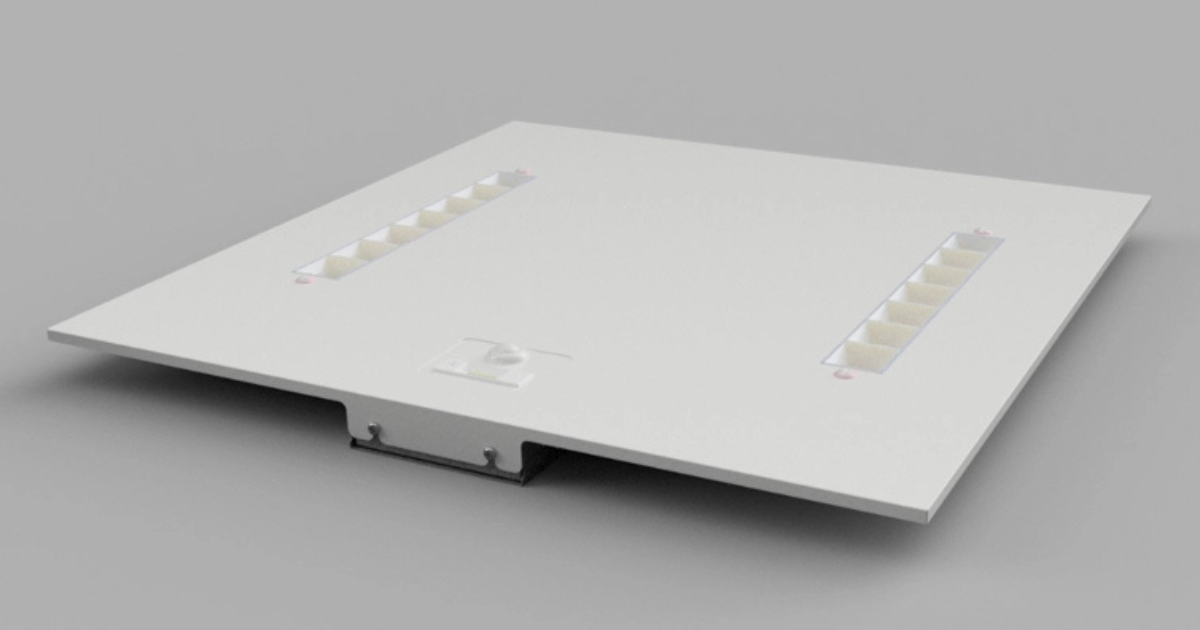
Our DfR Panel — a square LED ceiling panel designed for long life, easy serviceability and end-of-life remanufacture — scores 2.5 against the CEAM-Make method, a result in the top band of the TM66 scale. The assessment covers design, materials, manufacturing and ecosystem, question by question, with evidence behind the answers.
The point isn't the certificate. It's that the method is published, the questions are fixed, and the scoring is the same for every manufacturer — so choosing circular lighting doesn't have to mean taking anyone's word for it, including ours.
Not sure whether your existing fittings would score well against something like this — or whether they're worth keeping at all? Start with a Lighting Decision Audit. We'll tell you straight what's worth remanufacturing, what's worth keeping, and what genuinely needs replacing — before you commit to anything.
Conversation, not tender
Start with a conversation.
No tender process required. No sales pressure. A straight answer about what your estate is worth.