
Case study · Remanufacture
Thirty-six failed LED fittings. Not one of them replaced.
FES FM Limited, on behalf of Aberdeenshire Council — two care homes, one first-generation LED bulkhead with no spares path, and a different answer to failure.
The first generation of LED is now reaching the end of its life. It was sold as fit-and-forget — sealed units, no serviceable parts, no spares path. When those fittings fail, the industry's default answer is to buy them again.
Two Aberdeenshire care homes found a different one.
The problem
Out of production, with no route to a repair.
FES FM Limited, working on behalf of Aberdeenshire Council, had failed lighting in two care homes: ten round bulkheads and twenty-six emergency versions of the same fitting. First-generation LED, out of production, with no route to a repair.
Replacement was the obvious option and the expensive one. New fittings meant new capital cost, a changed ceiling appearance in a residential setting, and thirty-six perfectly sound housings in a skip.
FES asked us whether the fittings could be brought back instead.
What we did
Remanufacture, to a mix of original and replacement components.
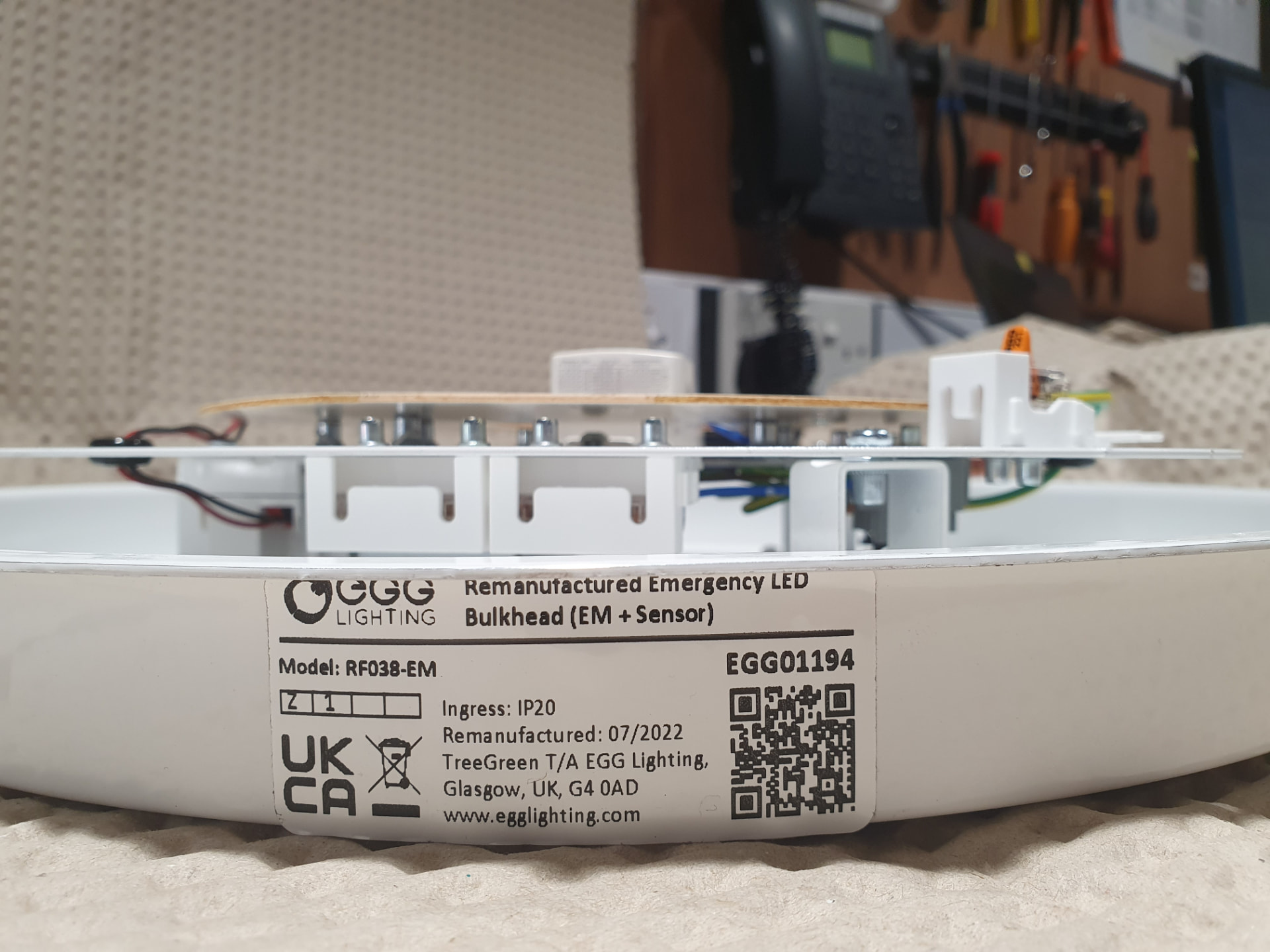
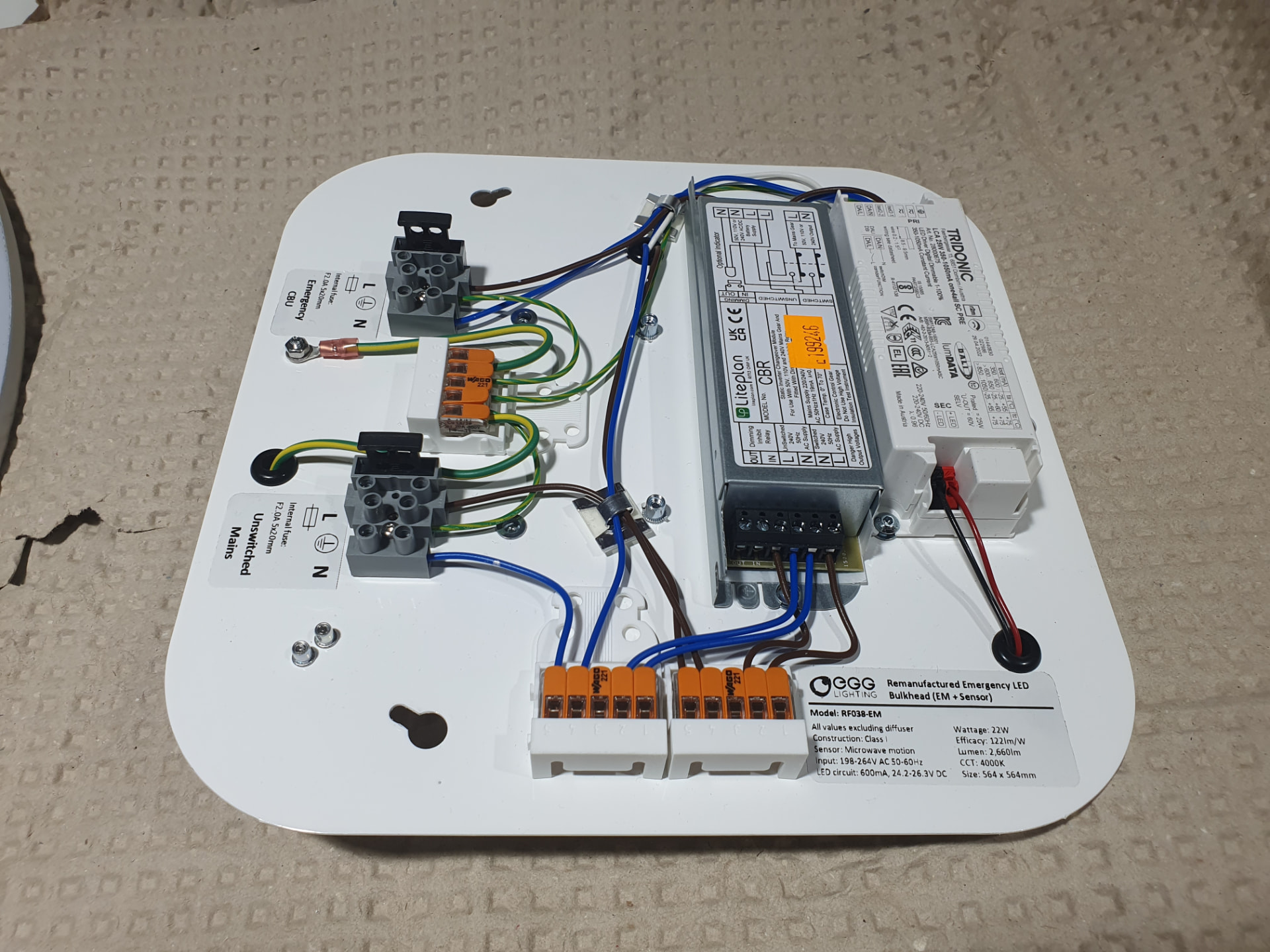
The diffuser, bezel and steel body were sound, so they stayed — about 1.9kg of material per fitting that never needed making again. Everything that had failed or aged was renewed: a new Tridonic LED module, a new programmable driver, new wiring and terminals, and on the emergency units a new changeover relay module. Each fitting came back with a new UKCA mark and legal responsibility for the modified product sitting with us.
The result was better than the fitting had been on the day it was first installed. And on the measure that is hardest to argue with — the carbon locked up in making the thing — a remanufactured standard fitting came out at 31.1 kgCO₂e against 63.8 for a new equivalent. Roughly half. The emergency version, which carries more new electronics, came out at 52.4 against 85.0.
Both assessed by us to CIBSE TM65-2:2023, the lighting-specific method, with the workbooks to show for it.
Before and after
The same fitting, in the same ceiling — brighter, cleaner, cooler in colour.
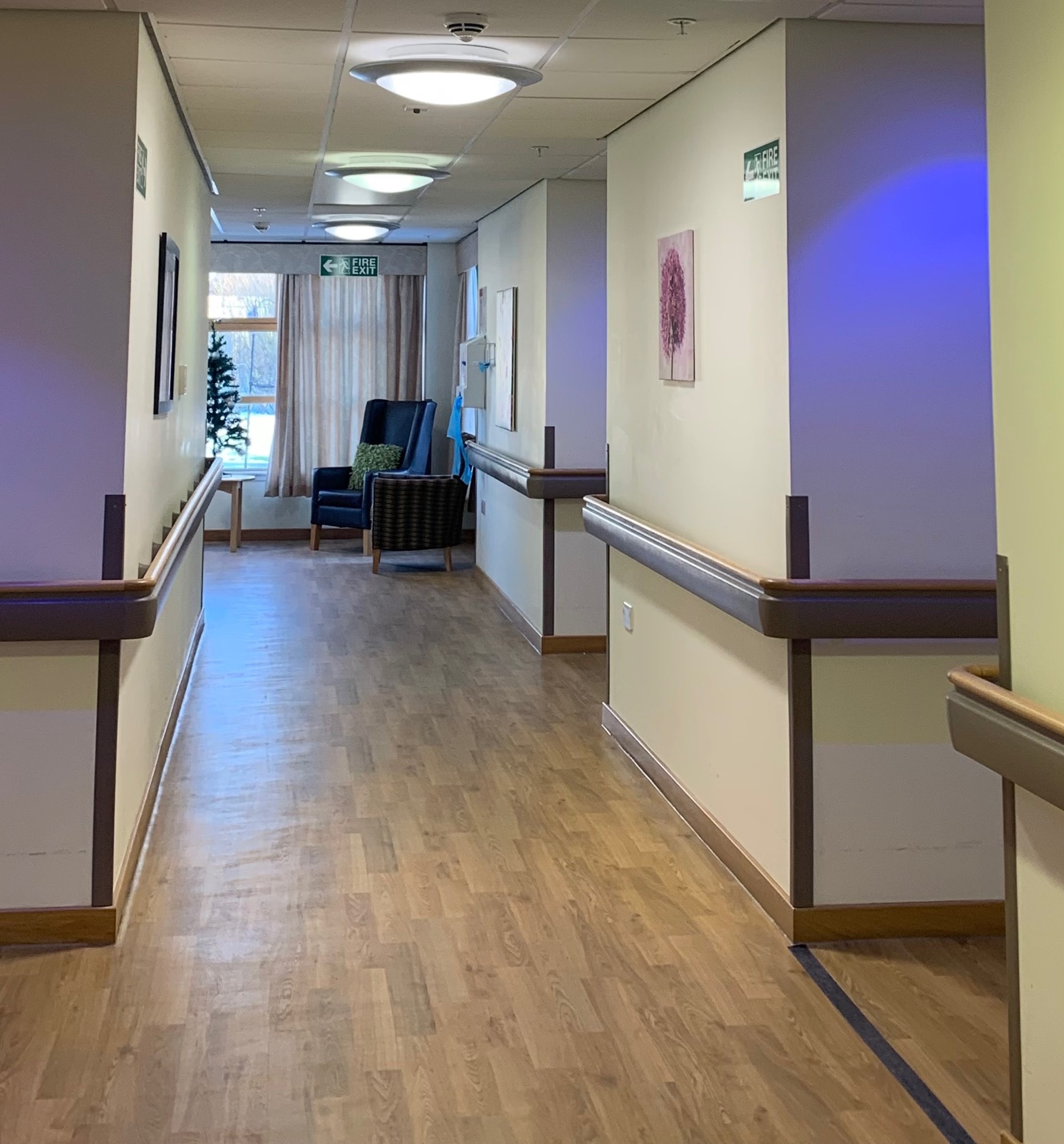
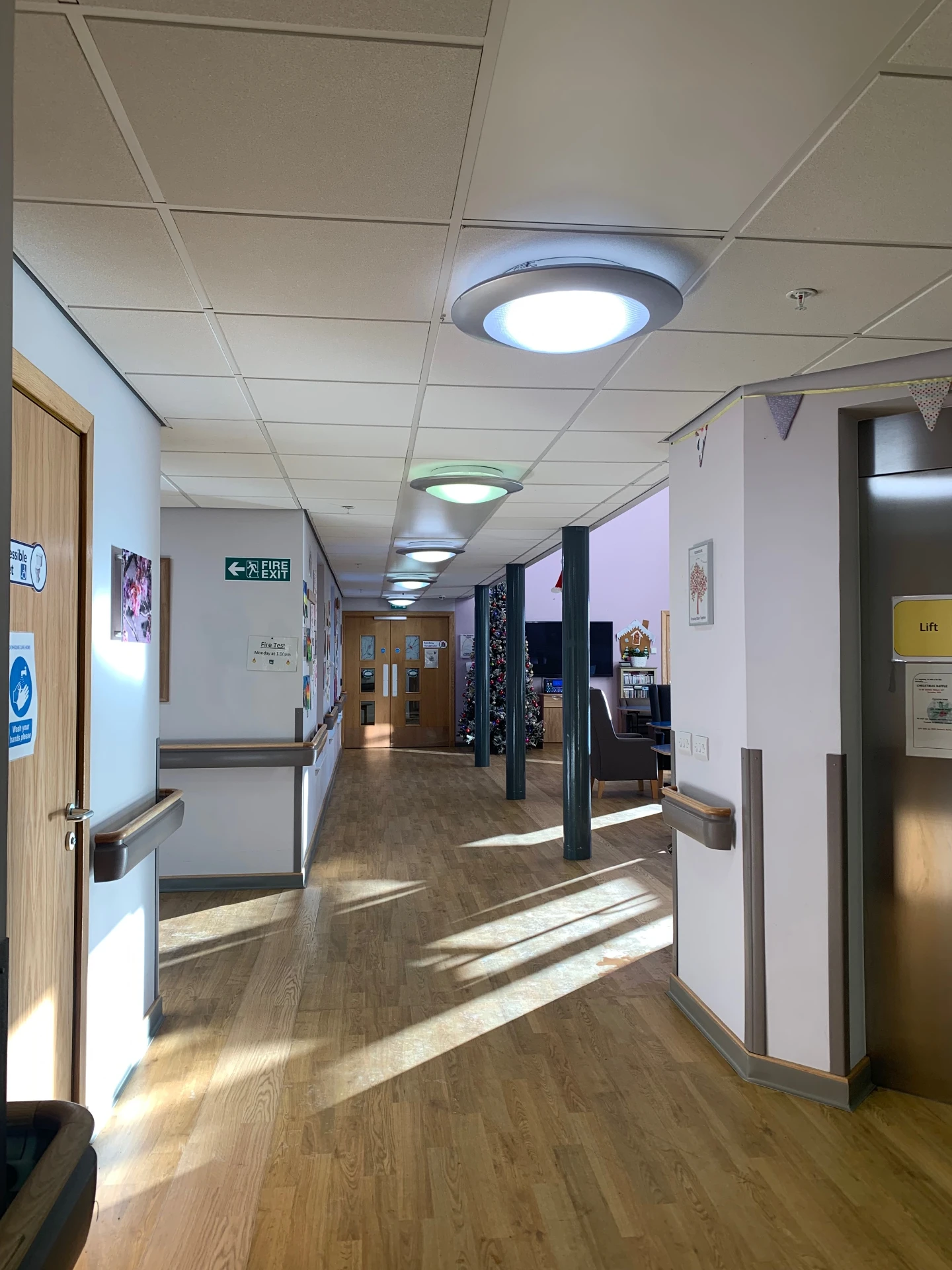
Residents kept the ceiling they knew — same housings, same aesthetic, renewed light output and a presence sensor in every fitting.
Before the thirty-six, there were two
A test, on their own fittings.
A year earlier, Aberdeenshire Council had asked us to remanufacture two fittings — one emergency, one standard. Not a programme. A test, on their own fittings, at a cost that needed no business case.
The thirty-six followed. And what the test established was that the work was harder than we had assumed: the costing for the full project was revised upwards because of what those two fittings taught us, not down.
We would rather find that out on two fittings than on three hundred. That is the entire argument for assessing before you commit.
The part that matters
The client didn't bank the saving. They spent it on capability.
Remanufacture cost less than replacement. Rather than take that difference as a reduced invoice, Aberdeenshire Council spent it on a microwave presence sensor in every luminaire — turning a corridor that had switched harshly on and off into one that dims smoothly. The fittings also came back modular, so the council's own maintenance team can service and upgrade them in future without calling anyone.
Not that it is cheaper. That it is the cheapest moment an estate will ever have to make its lighting better.
The numbers
Per fitting — the figures that transfer to any estate.
less embodied carbon, standard fitting — 31.1 kgCO₂e against 63.8 new
less embodied carbon, emergency fitting — 52.4 kgCO₂e against 85.0 new
of metal and plastic retained in every fitting rather than remade
warranty, new UKCA mark, legal responsibility for the modified product with us
Across the programme
fittings returned to service — 13 emergency, 12 standard
embodied carbon avoided
of material kept in use rather than scrapped
Embodied carbon assessed by EGG Lighting to CIBSE TM65-2:2023 — the lighting-specific method — separately for each variant, mid-level calculation with the standard 1.3 buffer factor applied.
“When our lights started to fail EGG Lighting gave us a solution that meant we were able to maintain original aesthetic, reduce energy consumption, keep our costs low and within budget, and improve our embodied carbon footprint. By remanufacturing the lights we were able to upgrade our fixtures on a reactive maintenance schedule without the high costs of a full replacement light.”
Why this one is worth reading
Thirty-six fittings is not a capital programme. It is a maintenance problem.
The kind that arrives unannounced, has no budget line, and gets solved by replacing whatever broke.
That is exactly where the cost accumulates across an estate. And it is where the first generation of LED is about to land, in thousands of buildings that were told the lighting was sorted for twenty years.
If your fittings are starting to fail and nobody can tell you what the spares path is, that is worth knowing before the invoice arrives.
Conversation, not tender
Start with a conversation.
No tender process required. No sales pressure. A straight answer about what your estate is worth.